
When we think about fitness as we get older, we tend to think and talk about strength, stamina, or flexibility. But there is another vital pillar of health that rarely gets the spotlight until it suddenly lets us down: our balance.
In our 20s and 30s, balance is something we take entirely for granted. But after the age of 40, the complex systems that keep us steady on our feet begin a subtle decline. The good news? Balance isn’t a fixed trait – it is a skill. And just like riding a bike or playing an instrument, it can be trained, protected and improved at any age.

The Body’s Internal GPS: What is Proprioception?
Balance relies heavily on a hidden superpower called proprioception. Think of this as your body’s internal GPS system. It consists of thousands of tiny, specialised sensors hidden within your joints, muscles and tendons.
These sensors constantly send lightning-fast signals to your brain, telling it exactly where your limbs are in space without you having to look down at your feet.
When you lose a bit of balance, it’s often because this internal GPS signal has gone “fuzzy.” Because we spend our lives in stiff shoes and walking on perfectly flat, concrete surfaces, these sensors go to sleep. When the signal degrades, your brain loses its ability to make micro-adjustments on the fly, making an uneven pavement or a slippery garden path feel incredibly vulnerable.

The Hidden Cost: Muscle Guarding and Fear
When your balance begins to slip, the effects aren’t just physical, they are psychological.
When your brain realises its internal GPS is offline, it panics. To protect you from falling, it commands your muscles to “lock down.” This is why poor balance often shows up as chronic stiffness in the lower back, hips, and calves. Your body is physically bracing itself against the fear of a fall.
By actively training your balance, you aren’t just preventing trips; you are teaching your nervous system that it is safe, allowing those tight, guarded muscles to finally let go and relax.

How Pilates Safely Reboots Your GPS System
Throwing yourself straight into standing on one leg on a wobbly foam cushion can feel terrifying and unsafe. That is why Pilates is so effective, it offers a graded, logical progression to safely wake up those nerve pathways.
We start by rebuilding your balance from the mat. Certain exercises challenge your stability while you are safely supported by the floor. This lets you train your core anchor without the fear of falling.
Once your nervous system feels confident, we transition to standing work, while we challenge your feet and ankles to “read” the ground again. Step by step, we clear up the fuzzy GPS signal so you can move through real life with total confidence.
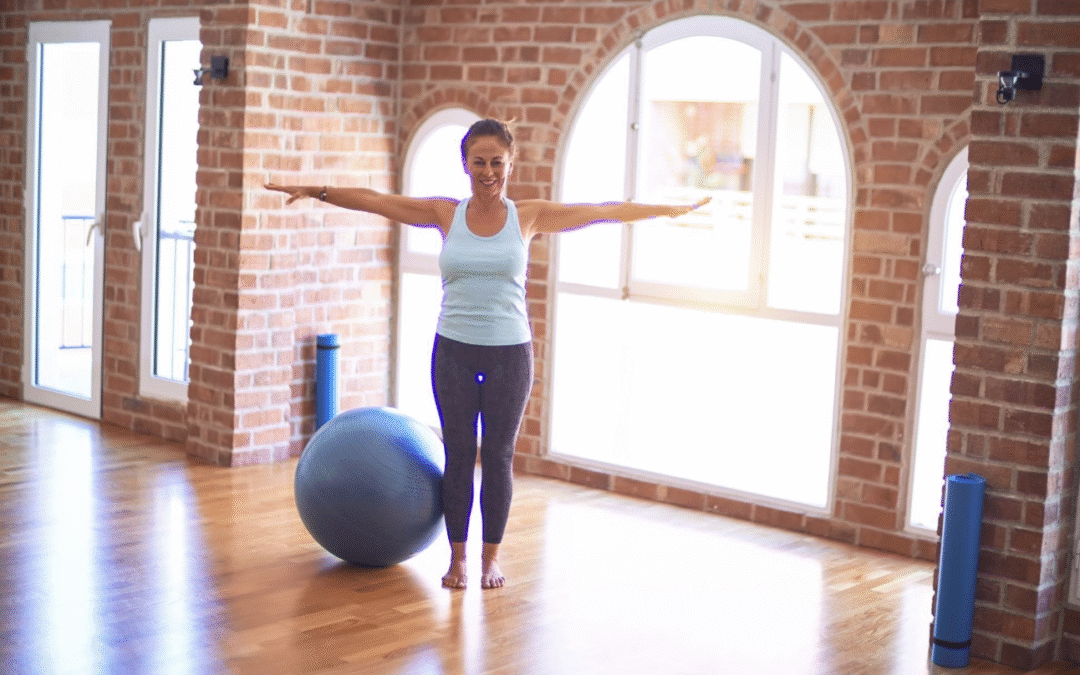
Pilates balls are excellent for balance. Because the balls provide an unstable surface, they force your body to constantly adapt, which activates your deep core stabilisers and improves overall coordination.

Your Daily Balance Practice
The beautiful thing about your internal GPS is that you don’t need to carve out a massive chunk of time to train it. We suggest weaving simple, micro-challenges into your normal daily routine.
Try adding these three simple habits into your week:
- The Toothbrush Test: While brushing your teeth morning and night, try standing on one leg. If that feels easy, try slightly hovering your hands away from the sink basin. Bonus challenge: Try closing your eyes for just 3 seconds, you’ll instantly feel your ankle muscles wake up and start working overtime!
- The Sit-to-Stand Challenge: When you get up from the sofa or a kitchen chair, try doing it without using your hands to push off. This builds the raw thigh and glute power needed to quickly steady yourself if you trip on a paving stone.
- The Kettle-Wait Backward Walk: While waiting for the kettle to boil, take 5–10 slow steps backward across your kitchen (make sure the space is clear first!). Walking backward forces your brain to rely 100% on those internal joint sensors rather than your eyes, instantly sharpening your coordination.
